
|
|
|




|
Pegasus Environmental, Ltd. was formed in 1993 as an aerial sensing corporation, providing multi-spectral imagery to the agricultural and golf course imagery. For more than a decade, Pegasus Environmental gave land managers a "stress map" of current vegetation, enabling them to "spot treat" areas requiring remedial action, as opposed to more liberal, conventional broadcasting of chemicals. Pegasus Environmental became an effective pest management tool. From the core business of Pegasus Environmental, a fascinating offspring known as Pegasus Ecological, Ltd. took flight in 1997. This subsidiary was formed as a joint venture to provide subcontracted flight services to an upstart company known as Pictometry International, GER Corp. and Terra Industries. When the terrorist attacks of 9/11 caused severe restrictions of flight paths in 2001, Pegasus Environmental, Ltd. turned to soil mapping using electromagnetic induction to provide spectral soil variation maps as a guide for agricultural management. Soon, it became apparent that within the golf course industry, a much more precise form of subsurface investigation was necessary. In 2002, Pegasus Environmental Company was formed to develop a Ground Penetrating Radar process that could output 3D profiles and drain tile locations on putting greens. Pegasus Environmental Co. collected analytical data for many of the nation's premiere golf courses, including Wing Foot Country Club in Westchester, N.Y., Oak Hill in Rochester, N.Y., Trump International, Hilton Head, Sea Island Golf Club on the Georgia coast, and other in New Hampshire, Alabama, Florida and the Carolinas. |
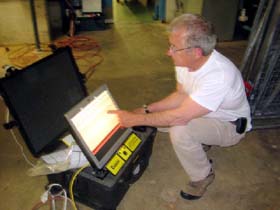
Technological advances led Pegasus Environmental to focus on using GPR in the biulding and construction trade as a means to develop spectral mapping for concrete structures, foundations and utilities that might lie below the concrete. GPR readings for concrete tend to be far more accurate than those for soil, and Pegasus now provides detailed reports for engineers, architects, property management companies and contractors using non-destructive subsurface analysis. Zeke Hurd founded Pegasus Environmental, Ltd. and Pegasus Environmental Company. After Cornell University, he spent four years in the U.S. Marine Corps as an artillery officer. Upon returning to his family's fruit farm, Hurd Orchards, in Holley, N.Y., he utilized his skills as a pilot to develop aerial sensing capabilities to predetermine where outbreaks of apple scab and fire blight might occur. The rest, as they say, is history. |

 |
|
|
|
|
|
|
|
|
|
|
|
|
|
|
|
|
|
|
|
|
|
|
|
|
|
|
|
|
|
|
|
|
|
|
|
|
|
|
|
|
|
|
|
|
|
|
|
|
|
|
|
|
|
|
|
|
|
|
|
|
|
|
|
|
|
|
|
|
|
|
|
|
|
|
|
|
|
|
|
|
|
|
|
|
|
|
|
|
|
|
|
|
|
|
|
|
|
|
|
|
|
|
|
|
|
|
|
|
|
|
|
|
|
|
|
|
|
|
|
|
|
|
|
|
|
|
|
|
|
|
|
|
|
|
|
|
|
|
|
|
|
|
|
|
|
|
|
|
|
|
|
|
|
|
|
|
|
|
|
|
|
|
|
|
|
|
|
|
|
|
|
|
|
|
|
|
|
|
|
|
|
|
|
|
|
|
|
|
|
|
|
|
|
|
|
|
|
|
|
|
|
|
|
|
|
|
|
|
|
|
|
|
|
|
|
|
|
|
|
|
|
|
|
|
|